The evidence

Why white fillings let back teeth down

Tooth-coloured composite looks great on a front tooth. On a molar or premolar — where nobody sees it and the chewing forces are huge — it wears, shrinks, leaks and fractures far sooner than metal. Here is what that looks like, case by case.

Graphic content warning. This page shows real clinical photographs of dental decay and damaged teeth, which some people find distressing. Every clinical photo is hidden and blurred by default — you have to tap “Tap to view” on each one to reveal it. The line drawings are schematic illustrations, not photographs.

Why back teeth are the hard case

Molars and premolars do the heavy chewing. They take hundreds of kilograms of force a day, sit in a warm, wet, sugary environment, and are hard to keep perfectly dry while a filling is placed. Tooth-coloured composite was designed first for looks on front teeth — and on a back tooth, where nobody sees it, its weaknesses matter far more than its appearance.

Below are the four ways a composite most often fails back here. Each shows a schematic illustration of the problem, a real clinical photo of the same failure, what happened, and why.

Composite still has its place — on visible front teeth, and for small repairs. Our concern is specifically the load-bearing chewing surfaces of molars and premolars, where a metal-based restoration will almost always outlast it.

Four ways it goes wrong

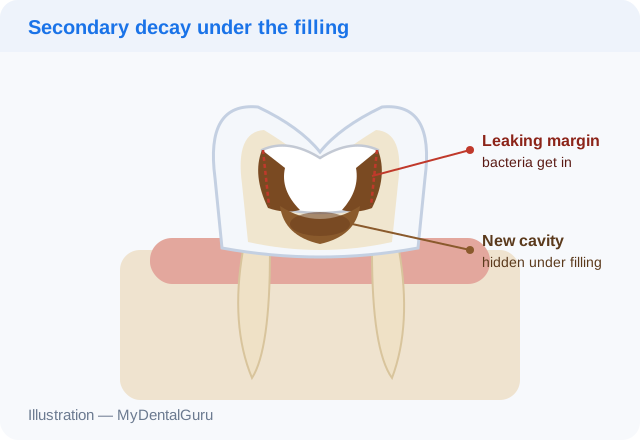
new decay under the edge of a composite filling
Illustration: new decay under the edge of a composite filling
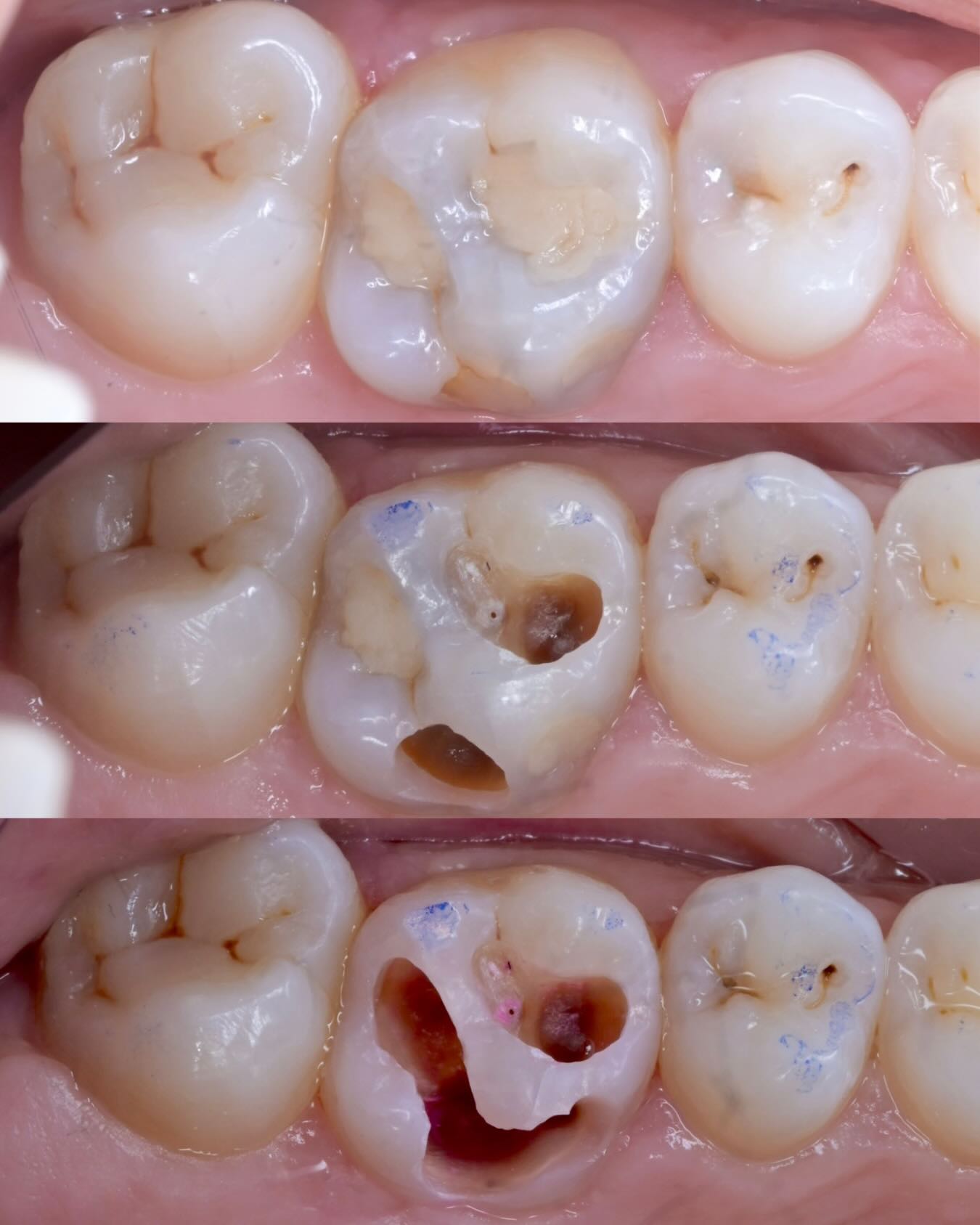
new decay under the edge of a composite filling
Real case photo
Recurrent decay

New decay grew back under the filling

What happened. A white composite filling was placed in a lower molar. Within a couple of years decay reappeared — not on a fresh part of the tooth, but right along the edge of the filling, spreading underneath where nobody could see it. The tooth had to be re-drilled, and more healthy tooth was lost to make room for the replacement.

Why it happened. Composite is held in by an adhesive layer that can shrink and break down over time, opening a microscopic gap at the margin. Composite surfaces also tend to gather more plaque bacteria than metal does, so that leaking edge becomes an easy route for a new cavity to start under the filling. Recurrent decay at the margin is one of the most common reasons back-tooth composites need redoing.
a shrinkage gap and crack beside a composite filling
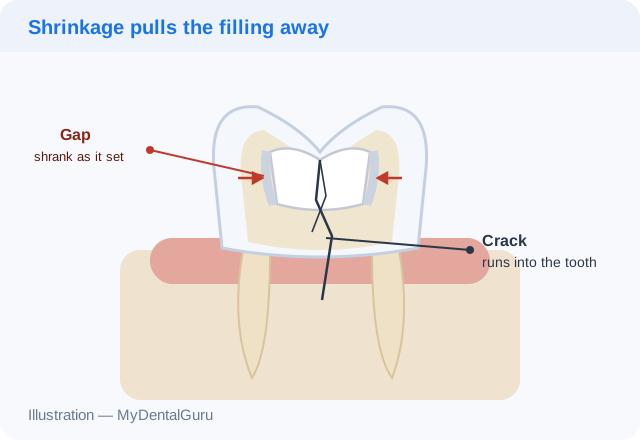
Illustration: a shrinkage gap and crack beside a composite filling
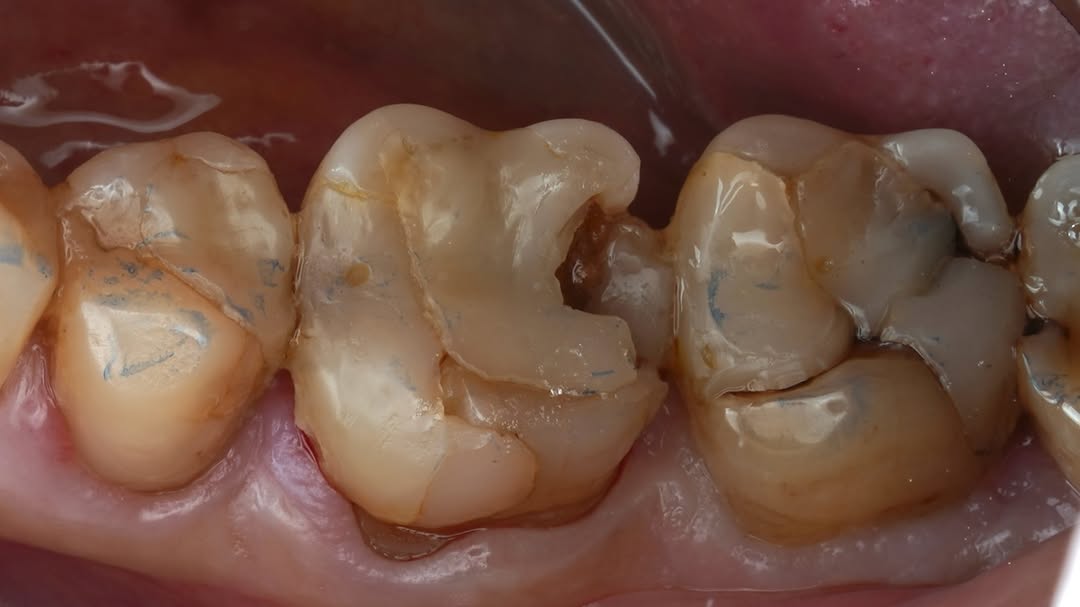
a shrinkage gap and crack beside a composite filling
Real case photo
Shrinkage & cracking

It shrank as it set — and cracked the tooth

What happened. Soon after the filling was placed, the patient had sharp sensitivity to cold on a back tooth. From above the filling looked fine, but as it hardened it had pulled slightly away from one wall, and a fine crack had run from the filling down into the tooth.

Why it happened. All composite shrinks a little as it cures (polymerisation shrinkage). In a deep back-tooth cavity that pull either opens a gap at the margin or leaves stress locked inside the tooth — which shows up as lingering sensitivity, a crack, or both. A cemented metal filling does not set by shrinking, so it never builds in that stress.
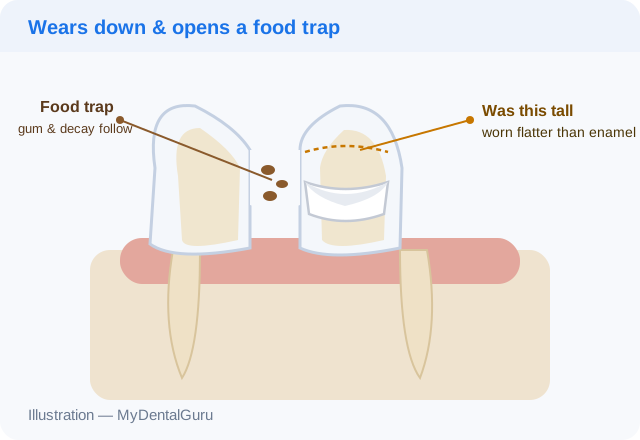
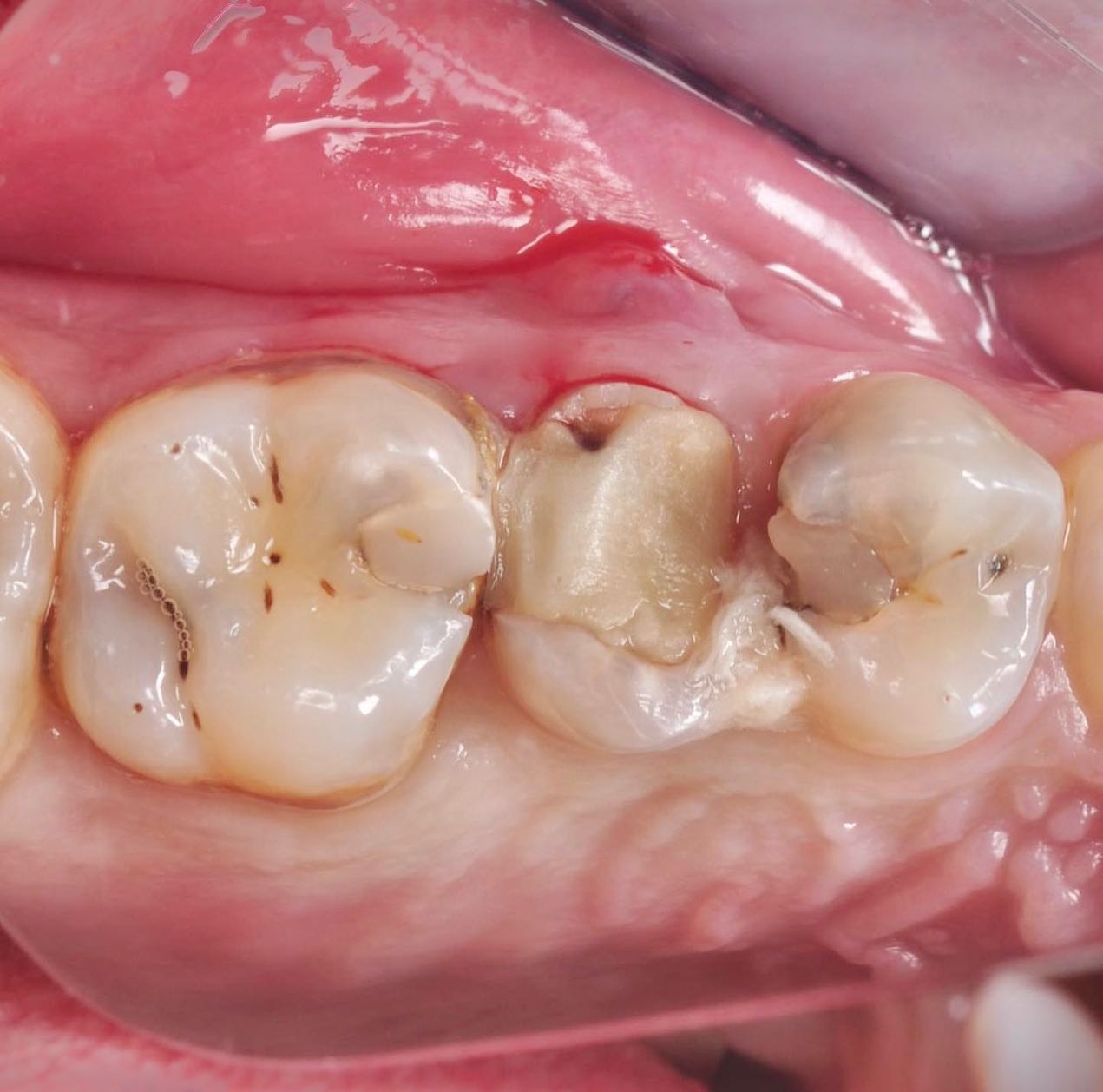
a worn composite that has opened a food trap between molars
Illustration: a worn composite that has opened a food trap between molars
a worn composite that has opened a food trap between molars
Real case photo
Wear & food trap

It wore down and opened a food trap

What happened. A large composite on a chewing surface slowly wore flat, dropping below the height of the tooth next to it. The tight contact between the two teeth opened, and food began packing into the gap after every meal — leading to sore, inflamed gum and a new cavity on the neighbouring tooth.

Why it happened. Composite is softer than enamel and than metal, so on load-bearing molars it wears and loses its shape faster. When a filling loses height the bite and the contact point change, and an open contact between molars is a classic cause of food impaction, gum problems and decay on the tooth beside it.
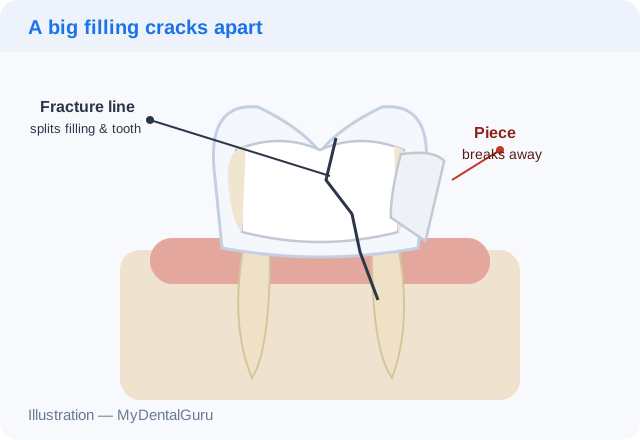
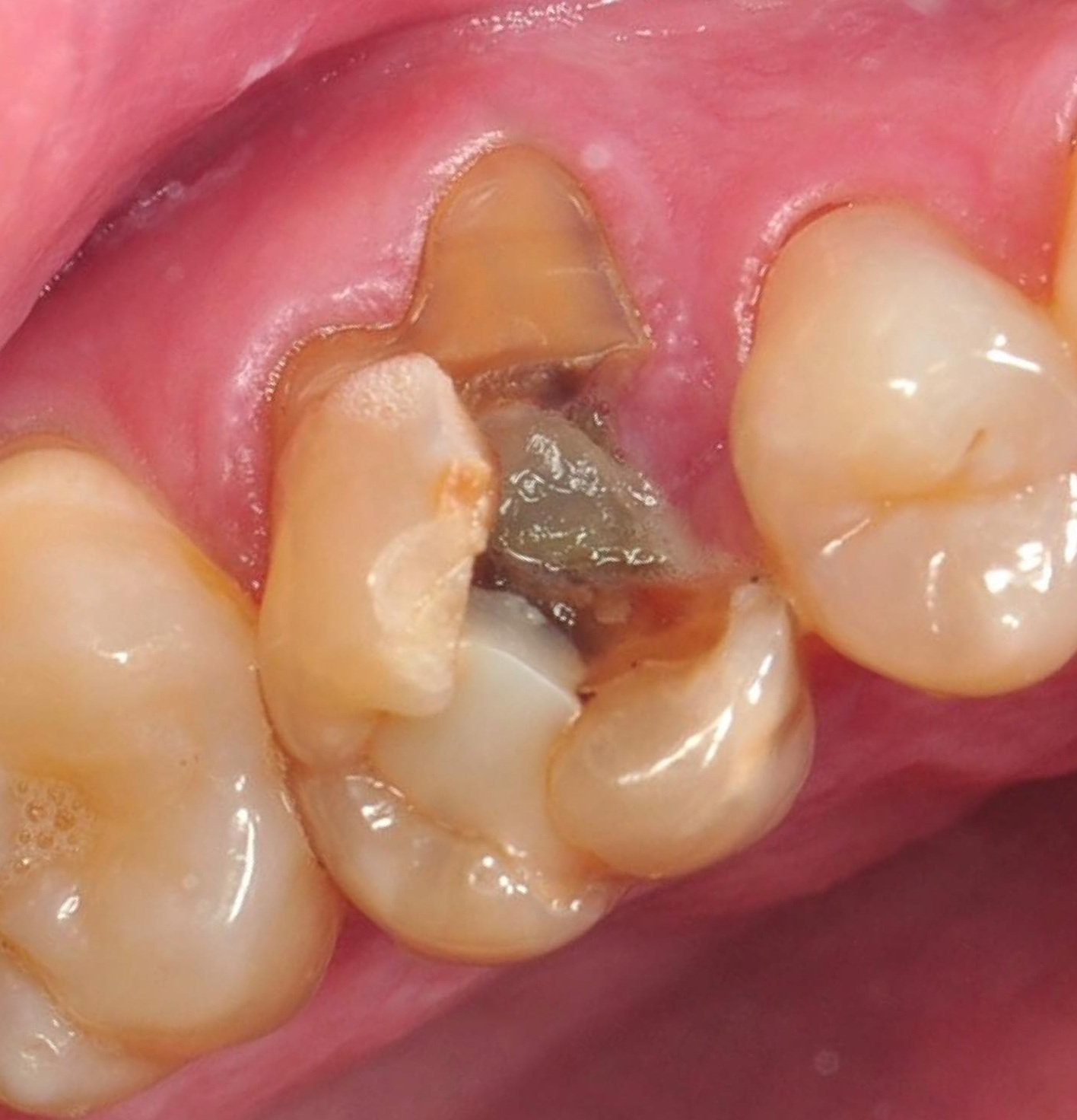
a large composite that has fractured and broken away
Illustration: a large composite that has fractured and broken away
a large composite that has fractured and broken away
Real case photo
Fracture

A large filling cracked and broke apart

What happened. A molar had been restored with a big composite covering most of the chewing surface. Biting on something hard, a whole section fractured away — taking a weakened wall of the tooth with it — and the restoration had to be rebuilt much larger than before.

Why it happened. The bigger a composite gets, the more it is asked to do the job of the missing tooth itself — which it isn’t strong enough to do on a molar long term. Large posterior composites fracture and de-bond more often than a cemented metal or gold inlay or onlay, which is made outside the mouth to full strength and holds the tooth walls together instead of relying on a bond.

The chemistry nobody mentions

A “white” filling is a plastic. It is built from resin monomers — most commonly Bis-GMA, which is made from bisphenol-A (BPA) — together with related compounds such as TEGDMA and UDMA. So the material being cemented into a chewing tooth is, chemically, a BPA-derived plastic.

BPA is a hormone-mimicking (endocrine-disrupting) chemical. That is not fringe opinion — it is why the EU has driven it out of the products that touch your food. BPA has been banned from baby bottles since 2011, and under Regulation (EU) 2024/3190 it is now banned from food-contact materials such as tin-can linings and drinks bottles (in force from 2025). In 2023 the EU’s food-safety authority (EFSA) cut the tolerable daily intake of BPA by roughly twenty-thousand-fold after reviewing its effects on the immune and hormonal systems. Regulators decided BPA does not belong in a food can. It is fair to ask why you would want it set into a tooth.

And it does not simply stay put. Un-set (uncured) resin monomers are cytotoxic to cells in the laboratory, and BPA is measurably released from fresh composite: studies have recorded salivary and urinary BPA rising by more than 40% in the 24 hours after fillings or sealants are placed. Amalgam and gold contain no resin monomers and no BPA — none of this chemistry applies to them.

Does this cause cancer? Let’s be straight with you. Hormone-mimicking chemicals like BPA are under active scientific investigation for a possible role in hormone-driven diseases, and that is precisely why regulators keep tightening the rules around them. But we will not overstate it: no study has proven that a dental filling causes cancer in a human being, and the dose from a single filling is low.

Here is our point. “Not yet proven harmful” is not the same as “proven safe” — it is an open question that the authorities are treating with real caution. On a molar or premolar that nobody ever sees, why take on that open question at all, when a metal or gold restoration raises none of it and lasts longer too?

The metal options that hold up back here
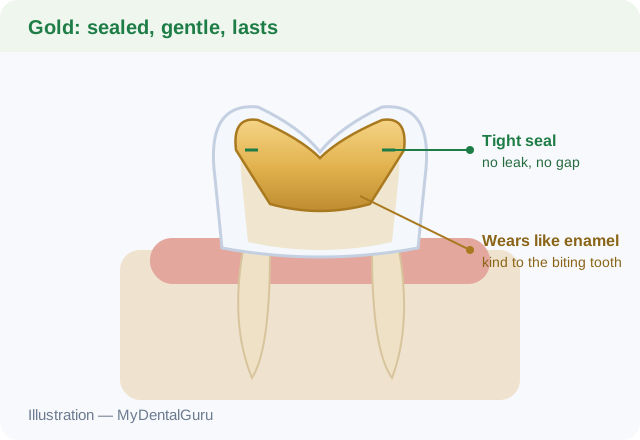
A gold restoration seals the tooth tightly and wears at the same rate as enamel

Whatever the size of the cavity, on a molar or premolar we point you at metal. Nobody sees it back there — and metal beats tooth-coloured composite on every measure that actually matters on a chewing surface: it does not shrink as it sets, it seals for longer, it resists wear and fracture, and it does not carry composite’s resin chemistry. Three options, in order of what most people choose:

  • Silver amalgam filling — the best all-round choice. A century of clinical use, extremely durable, and uniquely tolerant of a slightly damp tooth — so it still seals well on molars that are hard to keep perfectly dry. It is also the lowest-cost long-lasting option, and it contains no resin and no BPA.
  • Gold inlay, onlay or crown — the premium choice if the budget allows. Made outside the mouth to full strength and cemented in. It seals tightly, wears at almost the same rate as your natural enamel, and expands and contracts with heat like a real tooth — making it the gentlest option for the tooth biting against it.
  • Metal inlay or onlay — for a large back-tooth cavity. A custom-milled metal restoration for when a plain filling would be pushing its luck. It holds the remaining tooth walls together and far outlasts a big composite, without the cost of gold.

A note for readers in the EU. Since 1 January 2025 the EU has banned dental amalgam (silver fillings) except in narrow medical cases, under the revised Mercury Regulation (EU) 2017/852. If you are treated in the EU, ask instead about a gold or metal inlay, onlay or crown — the same durability, and fully available. Amalgam remains a common, legal option in many countries outside the EU.

Frequently asked questions

Are you saying composite is dangerous?

No. We’re saying it’s the wrong tool for the hardest job in the mouth. On a chewing surface it wears, shrinks, leaks and fractures sooner than metal, so it gets replaced more often — and every replacement costs a little more tooth. For a visible front tooth, composite is a perfectly reasonable choice.

My dentist only offers white fillings. Why?

Tooth-coloured fillings are popular because patients ask for a natural look, and many practices have moved away from metal for cosmetic reasons. Popular isn’t the same as longest-lasting on a back tooth. It’s always fair to ask your dentist specifically about a gold or metal option for a molar or premolar.

How long should a back-tooth filling last?

It depends on the tooth and your bite, but as a rule of thumb a well-placed metal or gold restoration on a molar tends to outlast a composite in the same spot, often by years. On large back-tooth cavities the gap between them is widest.

Is composite ever the right choice for a back tooth?

Yes — for a small cavity, on a tight budget, or as a temporary measure, a composite can be perfectly sensible. The bigger the cavity and the heavier the bite, the more the balance tips toward a metal-based restoration.

Need a filling? Get it done for free

We collaborate with models and content creators: you record honest videos about your treatment experience, and we cover the dental work.

The line drawings on this page are schematic illustrations of common failure patterns. The photographs are real clinical cases. This page is general information, not personal medical advice — every mouth is different, so always discuss your options with a dentist before deciding on treatment.